The Schwartz Values Wheel: Ten Basic Human Values and How They Pull Against Each Other
The Schwartz values wheel is a circular diagram of the ten basic human values from Shalom Schwartz’s Theory of Basic Human Values, first published in 1992 and since tested with survey data from dozens of countries. It is one of the most widely used academic models of what people care about. The ten values, in circle order, are self-direction, stimulation, hedonism, achievement, power, security, conformity, tradition, benevolence and universalism. The wheel below shows them in that order with the four higher-order groups on the outer ring; the rest of this note explains how to read it.
What makes it a wheel rather than a list is the arrangement. Values next to each other on the circle share a motivation and tend to be pursued together. Values across from each other pull in opposite directions, so acting on one usually means giving up some of the other. Stimulation and security are opposites; so are power and universalism. That geometry explains why some choices feel easy and others feel like a tearing.
This note covers the ten values with examples, the four groups and two axes, the 2012 refinement, the two questionnaires, a set of reflective questions, and how to use the wheel with a team or client alongside a personal core values list.
The Schwartz values wheel diagram
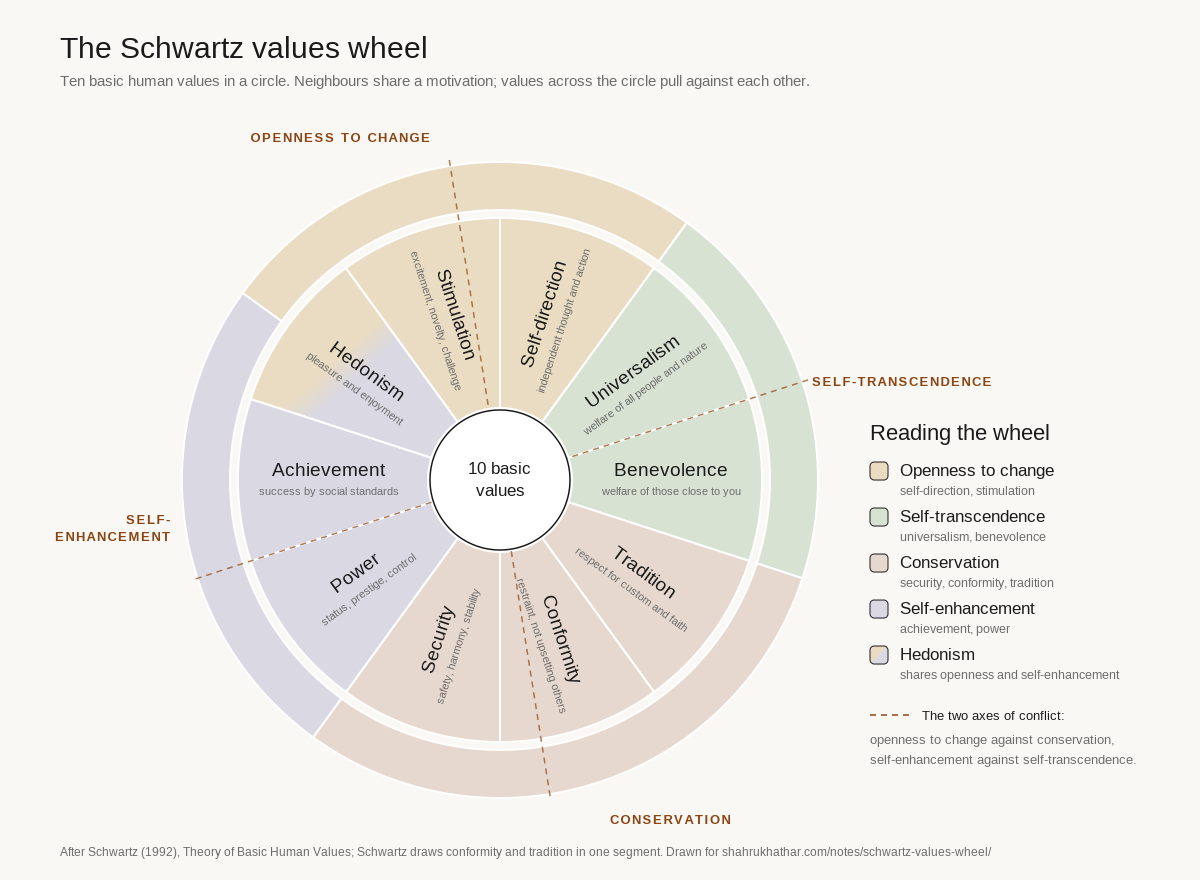
Read it as a map of distance. Each segment is one value, defined by the motivational goal it serves. Segments next to each other are compatible and tend to be pursued together; segments across the circle compete, so acting on one usually costs some of the other. The outer ring groups the ten into four higher-order values, and the two dashed lines mark the axes those groups form: openness to change against conservation, and self-enhancement against self-transcendence.
Two notes on the drawing. Schwartz places conformity and tradition in a single segment, tradition on the outside, because they share the goal of subordinating the self to social expectations; they are shown here as neighbours for legibility. Hedonism is shaded for both openness to change and self-enhancement because it shares something with each, which is why it sits on the boundary between them. If you want to rate how well your own values are being met, rather than study the research model, use the interactive values wheel instead; the two are different tools, as the section below explains.
The ten basic values on the Schwartz wheel
Schwartz defines each value by its motivational goal: the broad aim a person serves when acting on it. The definitions below follow those goals in plain language; the behaviours and sample sentences are my own illustrations, not part of the theory. The values run in circle order.
Self-direction
Independent thought and action: choosing, creating, exploring and deciding for yourself.
- Takes the role with less structure and more say over the method.
- Reads around a subject before accepting the standard view.
- Finds close supervision harder to bear than a heavy workload.
“Tell me the outcome you need and let me work out how to get there.”
Stimulation
Excitement, novelty and challenge: a varied life that keeps presenting something new.
- Changes jobs, cities or projects before most people would think it necessary.
- Books the unfamiliar destination over the one that was good last year.
- Gets restless once a routine starts to run smoothly.
“If I can predict how next year goes, I’ve already lost interest in it.”
Hedonism
Pleasure and enjoyment for oneself: gratifying the senses and savouring life.
- Protects the long lunch, the good meal, the holiday that is actually a holiday.
- Judges a week by how much of it was enjoyable rather than how much got done.
- Spends on comfort and experience rather than on things that signal status.
“What’s the point of all this if we never get to enjoy any of it?”
Achievement
Personal success through demonstrated competence, measured by standards other people recognise.
- Keeps score, even when nobody has asked for one.
- Volunteers for the visible project and finishes it.
- Feels a quiet week as a small failure rather than a rest.
“I want to be the person in the room who is clearly good at this.”
Power
Social status and prestige, and control or influence over people and resources.
- Notices who makes the decisions in a room and positions accordingly.
- Prefers the title and the budget to interesting work without them.
- Builds and guards a network, and knows the pecking order within it.
“I’d rather be the one setting the terms than the one agreeing to them.”
Security
Safety, harmony and stability: of yourself, your relationships and the society you live in.
- Reads the notice period and the pension terms before the salary.
- Keeps a cash reserve and an exit plan, even in a job they enjoy.
- Is unsettled by sudden change, however well it is presented.
“I need to know the ground isn’t going to move before I build on it.”
Conformity
Restraint of impulses and actions that would upset others or break social expectations and norms.
- Follows the process even when a shortcut would be quicker and unnoticed.
- Softens disagreement in meetings and raises it privately, if at all.
- Is embarrassed on behalf of people who make a scene.
“There’s a way things are done here, and I don’t see why I should be the exception.”
Tradition
Respect for and commitment to the customs and ideas handed down by one’s culture, family or religion.
- Keeps the festivals, the rituals and the family recipes, and passes them on.
- Weighs what their parents or community would make of a decision.
- Treats inherited practice as wisdom until shown otherwise.
“This is how my family has always done it, and I want my children to know it too.”
Benevolence
Preserving and improving the welfare of the people close to you: family, friends, colleagues, your own group.
- Is the person others call at two in the morning, and answers.
- Covers for a colleague without being asked and without mentioning it.
- Measures a decision by what it does to the people nearest to it.
“I don’t care about the policy. These are my people and I’m going to look after them.”
Universalism
Understanding, tolerance and protection for the welfare of all people and of nature, not only one’s own group.
- Changes what they buy, eat or drive because of its effect on strangers or the environment.
- Argues for the person who is not in the room and never will be.
- Is uncomfortable with any arrangement that works for insiders at the expense of outsiders.
“It isn’t enough that it’s good for us. Who pays for it somewhere else?”
The four higher-order groups and the two axes
Schwartz groups the ten values into four higher-order values, which form two bipolar axes across the wheel. Each axis names a conflict that recurs in almost every important decision.
| Higher-order value | Basic values | Broad motivation |
|---|---|---|
| Openness to change | Self-direction, stimulation (and hedonism, in part) | Independence of thought and action; readiness for new experience |
| Self-enhancement | Achievement, power (and hedonism, in part) | Pursuit of one’s own success and standing |
| Conservation | Security, conformity, tradition | Order, stability, self-restraint and preserving the past |
| Self-transcendence | Benevolence, universalism | Concern for the welfare of others, near and far |
The first axis runs from Openness to change to Conservation: wanting things new against wanting things to hold. The second runs from Self-enhancement to Self-transcendence: advancing yourself against serving others. Hedonism sits on a boundary, sharing something with both openness and self-enhancement, which is why it is often drawn straddling the two.
This is where the wheel beats a flat list. A list tells you what someone endorses, and most people endorse nearly everything. The circle tells you what they must give up to act on any one value. Someone high in both security and stimulation is not contradicting themselves; they carry a structural conflict that returns whenever a safe option and an exciting one are both on the table.
The 2012 refinement and the two instruments
In 2012 Schwartz and colleagues refined the theory, dividing the same circle into nineteen values. The order is unchanged; several of the ten are split. Self-direction becomes thought and action, power becomes dominance and resources, security becomes personal and societal, conformity becomes rules and interpersonal, benevolence becomes dependability and caring, and universalism becomes concern, nature and tolerance. Face and humility are added at the seams. For most practical work the ten are enough; the nineteen help when you need to separate a client who wants freedom in how they think from one who wants freedom in what they do.
The Schwartz Value Survey (SVS)
The original instrument. Respondents see a long list of single values, each with a short gloss, and rate how important each is as a guiding principle in their life. It is abstract and demanding, and works best with educated adult samples.
The Portrait Values Questionnaire (PVQ)
A later, more accessible instrument. Respondents read short portraits of a hypothetical person who cares about something and say how much that person is like them. Versions of different lengths exist, including a short form used in large cross-national surveys and a longer one for the nineteen-value theory. The format suits people who have never thought about values in the abstract.
Both are research tools with their own scoring conventions, so I do not reproduce their items here. For a proper score, use the published versions through a researcher or licensed platform. To think about your own values, the questions below need no questionnaire at all.
Questions to explore with the wheel in front of you
Draw or print the circle with the ten values in order, and work through these with one context in mind: your work, a relationship, money, the next year. Write the answers down. The value is in the specific decisions you remember, not the words you approve of.
- Which three values have you actually paid for in the last two years, in time, money, comfort or approval? Mark them.
- Which three do you say you hold but cannot find a decision that proves? Mark those differently. The gap is where to look.
- Are your marks clustered in one region or spread around the wheel? A cluster suggests a clear direction; a spread, a structural conflict.
- Take your strongest marked value. What sits opposite it, and when did you last feel that opposite pulling at you?
- Which axis is more alive for you right now: openness against conservation, or self-enhancement against self-transcendence?
- Think of the last choice you regret. Which value won, and which lost? Were they neighbours or opposites?
- Think of a choice you are proud of that cost you something. Same question.
- Which value do you find hardest to respect in other people? It is often one you have had to suppress in yourself.
- Which value have the people closest to you been asking you, directly or indirectly, to move towards?
- If your work moved one segment round the wheel, which direction would feel like relief, and which like loss?
- Which value carried more weight for you ten years ago than now? What happened?
- Describe your current life in two values, and your preferred life in two. How many segments apart are they?
Using the Schwartz wheel with a team or a client
In coaching and leadership work the wheel is most useful as a shared map, not a scoring system. It gives a neutral vocabulary for a conversation that is otherwise personal and easy to take badly. Three uses come up repeatedly.
- Locating a stuck decision. Ask the client to place both options on the wheel. If they land on opposite sides, the difficulty is not indecision but a real conflict between two things they value, and the question becomes which one they will pay for in this context.
- Explaining recurring friction. When two colleagues keep clashing over the same kind of issue, ask each to mark the region they mostly work from. A manager in conservation and a report in openness will have the same argument in different clothes until both see the pattern.
- Testing a team against its stated values. Many values statements sit in self-transcendence and openness; many reward systems sit in self-enhancement and conservation. Mapping both onto one circle makes the contradiction discussable without blame.
A worked example (composite)
The following is a composite built from patterns that recur across conversations. It is not a real client.
They place “take the money” near power and achievement: a bigger company, faster, with a title that means something.
They place “stay independent” near self-direction and security: no board, nobody to answer to, a business still theirs in ten years.
The two positions sit across the circle from each other.
Asked which value they have paid for in the last two years, they name self-direction at once. Asked which they talk about most: achievement.
The decision is still theirs. What has changed is that they can see it as a trade between two values they hold, not a question of courage.
Two rules in a session like this. The wheel is the client’s to mark, not mine; if they place a value where I would not have, I ask rather than correct. And I never use the model to tell anyone which end of an axis they should be on.
How the Schwartz wheel relates to your own core values
The wheel and a personal values list answer different questions. The wheel describes ten broad motivational goals found across cultures. A personal core values list is specific: the particular words, such as candour, loyalty or craftsmanship, one person uses to judge their choices. Most of those words map onto a region of the circle, loyalty near benevolence and tradition, craftsmanship near achievement and self-direction. The map does not replace the words; it shows where they sit relative to each other. So values elicitation produces the person’s own words and their order, and the wheel then shows which are neighbours and which are opposites. Two opposite values in the top three will produce the same dilemma again and again.
A note on the tools on this site. The interactive values wheel is a rate-your-values exercise: you choose your own top values and score how well each is being met right now. It is not Schwartz’s circle and does not place values in his order. The values inventory helps you shortlist and rank personal values in a chosen context, the values worksheet note gives a printable version of the same steps, and the values framework explains the wider model they sit inside.
For a vocabulary to work from before placing anything on the wheel, the full core values list with a one-line definition of each value is available as a printable PDF.
What the Schwartz wheel is not
The theory is a model of motivational goals and of how individuals and cultures prioritise them, and it is well supported for that purpose. It is not a personality test: it does not measure traits, abilities or mental health, and the link between a value score and any single decision is usually modest. It is not a clinical tool either. Nothing on the wheel is a diagnosis, and if the work brings up distress, that belongs with a qualified professional. Finally, it describes priorities at a point in time. Values are fairly stable in adults but move with major life events, so the order you draw today is a snapshot to think with, not a verdict.
Free instruments for this note
Values Wheel
Choose the six to eight values that matter most, rate how fully you are living each one right now, and see on one wheel where your life and your values have drifted apart.
Open itValues Inventory
What you say matters and what actually wins under pressure are often different. This ranks the six value orientations that drive your choices.
Open itQuestions people ask
What is the Schwartz values wheel?
A circular diagram of the ten basic human values from Shalom Schwartz’s Theory of Basic Human Values, first published in 1992. Neighbouring values share a motivation and opposite values conflict. It is used in cross-cultural research and, increasingly, in coaching to show which values pull against which.
Is there a Schwartz values wheel diagram?
Yes. The diagram at the top of this note shows the ten values in Schwartz’s circle order, the four higher-order groups on the outer ring and the two axes of conflict. It is a drawing of the published research model, not a questionnaire: for a scored profile you need the Schwartz Value Survey or the Portrait Values Questionnaire through a researcher or a licensed platform.
How many values are in the Schwartz model?
The original theory has ten: self-direction, stimulation, hedonism, achievement, power, security, conformity, tradition, benevolence and universalism. A 2012 refinement divides the same circle into nineteen, adding face and humility and splitting several of the ten. The order around the circle is the same in both.
What are the four higher-order values?
Openness to change (self-direction, stimulation), self-enhancement (achievement, power), conservation (security, conformity, tradition) and self-transcendence (benevolence, universalism). Hedonism sits between openness and self-enhancement. They form two axes: openness against conservation, and self-enhancement against self-transcendence.
Is the Schwartz wheel the same as a values wheel worksheet?
No. A values wheel worksheet, including the interactive one on this site, asks you to pick your own top values and score how well each is currently met. The Schwartz wheel is a fixed research model with ten values in a set order, built to show which values share a motivation and which conflict.
Who is the Schwartz values wheel for?
Researchers use it to compare value priorities across people and cultures. Coaches, leaders and anyone reflecting on their own choices can use it as a map for why a decision feels like a trade-off, or why two people keep clashing over the same issue. It is not a personality test or a clinical instrument.
How do I find my own values with the Schwartz wheel?
Draw the circle, pick one context such as work, and mark the values you have actually paid for in real decisions rather than the ones you approve of. Then look at where the marks fall: clustered on one side, or spread across opposites. For your own words rather than Schwartz’s ten categories, pair the wheel with a values elicitation and a core values list.
Related
One useful observation,
no motivational sludge.
One useful observation about human behaviour, language, or decision-making — sent once a week. Unsubscribe any time. Prefer it live? Join the free monthly Pattern Clinic.